
Best Bank Statement Software for Lenders
Published on August 9, 2026 by CapyParse Team
Try it with your statement
Drop a PDF statement below to see the transactions extracted. Free, no signup.

Click to upload or drag & drop
your bank statement PDF
Select PDF filePDF only · up to 6 pages · 10 MB max
Need more pages or the Excel and QBO exports? Open the converter
Search for bank statement software for lenders and you get a list of products that appear to do the same thing and differ in price by two orders of magnitude. They are not doing the same thing. Underneath the marketing there are three separate jobs, and knowing which one you actually need is most of the buying decision.
The three layers
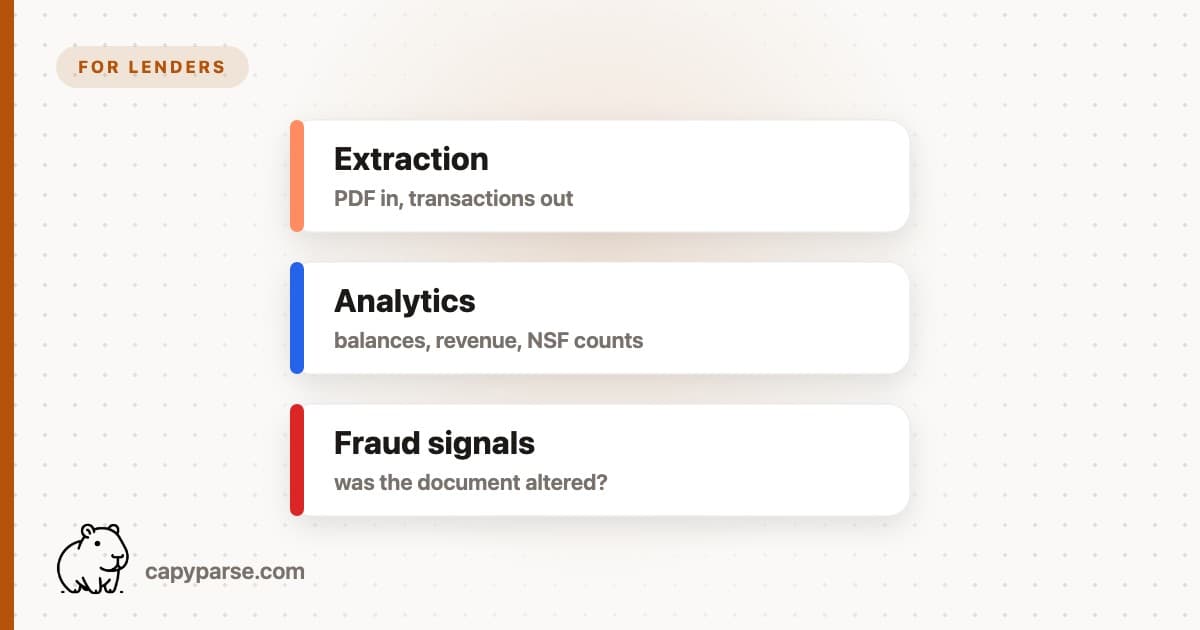
Extraction. PDF in, transactions out. Solved problem, priced per page, self-serve.
Analytics. Transactions in, underwriting signals out: average daily balance, revenue, NSF counts, recurring debits. Priced per file or per seat, usually quote-only.
Fraud detection. Was this document altered before it reached you? Almost always bundled with analytics.
A team that already has an underwriting model and needs clean data is buying layer one. A team building a lending product from scratch is probably buying all three. Paying enterprise prices for layer one because the vendor bundles two and three is the most common way money gets wasted here.
Who does what
| Tool | Extraction | Analytics | Fraud signals | Pricing |
|---|---|---|---|---|
| Ocrolus | Yes | Yes | Yes | Quote only |
| Heron Data | Yes | Yes | Yes | Quote only |
| Inscribe | Yes | Yes | Yes | Quote only |
| Prism Data | Via connections | Yes | Partial | Quote only |
| Docsumo | Yes | Validation rules | No | Quote, 1,000-page trial |
| MoneyThumb | Yes | Partial | Partial | $59.95 to $599, cloud from $24.95/mo |
| AWS Analyze Lending | Yes | No | No | $70 per 1,000 pages |
| CapyParse | Yes | No | No | $29/mo, self-serve |
The full-stack platforms
1. Ocrolus
The name most lending teams reach for first. Ocrolus processes bank statements, pay stubs, and tax documents, claims 99% or better accuracy, and layers cash flow analysis and income calculation on top. It works through both an API and a dashboard and integrates with loan origination systems, with vertical solutions for small business funding and mortgage.
The differentiator is fraud detection. Ocrolus examines documents for signs of tampering including font inconsistencies, metadata anomalies, and mathematical errors that suggest numbers were altered. For a lender receiving borrower-supplied PDFs rather than direct bank connections, that matters more than another point of extraction accuracy.
Pricing is not published. Expect a demo, a scoping conversation, and an annual commitment.
Best for: mortgage and small business lenders wanting one vendor for the whole document workflow.
2. Heron Data
Heron is built around transaction classification: identifying revenue, spotting recurring expenses, and surfacing the cash flow signals working capital lenders actually underwrite on. The company states it processes more than 500,000 files a week for over 150 customers, which is a meaningful scale claim in a market full of vague ones.
In January 2026 it launched Heron Broker Suite, extending from analysis into full deal flow automation for SMB credit brokers, covering application intake through to CRM. If you are a broker rather than a funder, that is a different product shape from everything else on this list.
Best for: working capital lenders and SMB credit brokers.
3. Inscribe
Inscribe's bank statement analyzer is aimed at teams where underwriting, fraud review, and compliance all read the same document. Its pitch is the fraud signals that extraction-only tools miss, which is a fair distinction: a converter that reads an altered statement perfectly will happily hand you perfectly extracted lies.
Suited to high-volume pipelines where manual review is the bottleneck rather than data entry.
Best for: fintechs where fraud review and underwriting share a queue.
4. Prism Data
Prism sits further up the stack, providing cash flow underwriting infrastructure and analytics rather than document processing. The thesis is that transaction data predicts repayment better than a credit score alone, particularly for thin-file borrowers.
Worth understanding where its input comes from. Cash flow underwriting built on bank connections is a different data path from one built on borrower-supplied PDFs, and if your borrowers email statements you still need the extraction layer in front.
Best for: lenders expanding approvals with cash flow signals alongside traditional scoring.
Extraction-focused options
5. Docsumo
Docsumo handles the document layer for lenders needing extraction from bank statements, tax returns, and income verification documents, with validation rules, auto-classification, and cross-document checks. Customers are cited as reaching above 95% straight-through processing.
The trial is unusually usable for evaluation: 1,000 pages over 14 days with ten user licences, which is enough to run a real sample of your own files rather than a demo document. Paid pricing is quote-based, and setup fees vary with complexity.
Best for: teams needing multiple document types extracted and validated, with the decisioning kept in house.
6. MoneyThumb
MoneyThumb has served this market for a long time, largely through desktop conversion products with analysis features layered on. Desktop licences run from $59.95 to $599 depending on edition, and cloud subscriptions are published at $24.95, $49.95, and $99.95 a month.
It is the only vendor here with transparent pricing and a genuinely small entry point, which makes it a reasonable starting position for a small funder. The trade-offs are the Windows requirement on several editions and the fact that the OCR module for scanned statements renews separately at around $99 a year.
Best for: small funders who want to start today without a procurement cycle. See our MoneyThumb review.
7. AWS Textract Analyze Lending
A purpose-built Textract mode for loan document packages, priced at $70 per 1,000 pages and dropping to $55 past a million. It classifies and splits the documents in a loan file and extracts from each, which removes a real chunk of preprocessing work.
It is a component, not a product. There is no underwriting view, no fraud scoring, and no reviewer interface. Note also that the pricing applies only to pages of supported document types, so a mixed package can behave unpredictably in a cost model.
Best for: engineering teams on AWS building their own loan document pipeline.
8. CapyParse: the extraction layer, honestly scoped
Straight answer first: CapyParse does not do cash flow analytics, income calculation, or fraud scoring. If you need those in one purchase, buy from the top of this list.
What it does is turn statement PDFs, including scans and photographs, into clean transaction data with the extracted rows reconciled against the balances printed on the statement. Rows that could not be confirmed are flagged rather than silently included, which is the property that matters when the numbers feed a credit decision. Output is CSV, Excel, or JSON through the API, and multi-account statements come back separated.
The case for it is cost and speed to start: $29 a month for 150 pages, $79 for 600, no sales call, no annual commitment. For a lender whose underwriting logic already exists and simply needs reliable input, that is the whole job at a fraction of platform pricing.
Pros
- Self-serve, published pricing, no commitment
- Balance reconciliation and flagged rows
- REST API returning JSON for your own models
Cons
- No underwriting analytics
- No document tamper detection
- No loan origination system integrations
Best for: lenders and brokers who own their underwriting logic and need dependable transaction data feeding it.
Test the extraction layer
Run a borrower statement through and see the reconciliation. 10 free pages, no sales call.
Try CapyParse FreeWhat fraud detection actually looks at
Vendors describe this in language that makes it sound like magic. It is not, and understanding the mechanics helps you judge the claims.
Document metadata
A statement produced by a bank's system carries a particular producer signature. One that has been through an editor carries a different one, and often a modification date.
Font and alignment breaks
Edited numbers rarely match the surrounding text exactly. A single line where the font metrics or baseline shift is a strong signal.
Arithmetic that does not close
Change one deposit and the running balance stops following from the transactions. Forgers routinely miss this, and it is the cheapest check to run.
None of it is proof
A legitimate statement re-saved by a customer's PDF viewer trips metadata checks. These are signals for a human reviewer, not verdicts.
Our guide to spotting fake bank statements covers the manual version of these checks, which is worth knowing even if software does the first pass.
The failure mode that costs the most
It is not a misread character. It is a page that was skipped, or a set of transactions where deposits and withdrawals were both read as positive. Either one moves average daily balance and revenue materially, and neither looks wrong on inspection. Whatever you buy, insist the extracted data reconciles against the printed opening and closing balances before it reaches a model.
Frequently asked questions
What is bank statement analysis software?
It covers three separate jobs that vendors often bundle. Extraction turns statement PDFs into transaction data. Analytics turns transactions into underwriting signals such as average daily balance, revenue, NSF counts, and recurring obligations. Fraud detection looks for evidence the document was altered. Some products do all three, many do one.
Which bank statement software do mortgage lenders use?
Ocrolus is the most established name in mortgage and small business lending, combining extraction with cash flow analytics and document tamper detection, and it integrates with loan origination systems. Heron Data, Prism Data, and Inscribe compete on the analytics and fraud side. All four are quote-only enterprise products.
How does bank statement fraud detection work?
Mostly by looking for inconsistencies a forger overlooks: PDF metadata that shows the file was edited, fonts that do not match across the page, alignment that shifts on one line, and arithmetic where the running balance does not follow from the transactions. None of these is conclusive alone, which is why the output is a risk signal for a human rather than a verdict.
Do you need enterprise software to process bank statements for lending?
Not for the extraction step. If your underwriting model already exists and you only need clean transaction data feeding it, a self-serve converter costs a fraction of an enterprise platform and starts working the same day. Enterprise platforms earn their price when you need the analytics, the fraud signals, and the loan origination system integration as one package.
What should you check before trusting extracted statement data in underwriting?
Confirm the extracted transactions reconcile to the opening and closing balances printed on the statement, that no page was skipped, and that deposits and withdrawals carry the correct sign. A missing page or a flipped sign moves average daily balance and revenue enough to change a decision, and neither shows up as an obvious error.