
Best Freight Document Automation Software
Published on August 9, 2026 by CapyParse Team
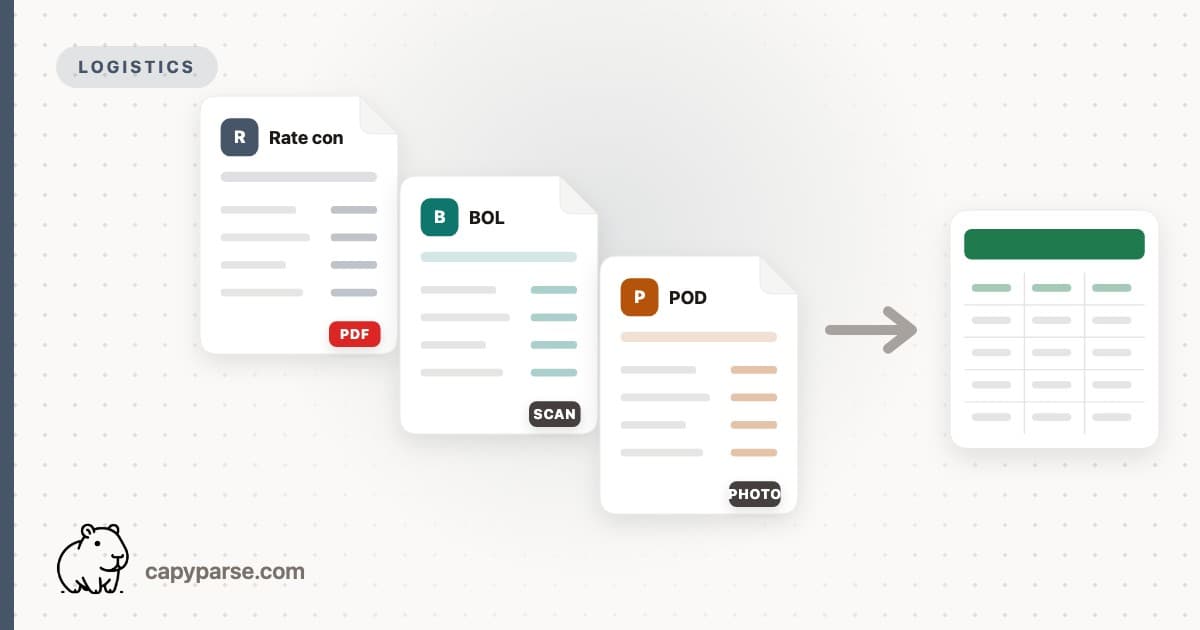
A single truckload generates a rate confirmation, a bill of lading, a proof of delivery, sometimes a packing list, and eventually a carrier invoice. Every one of those arrives as a PDF, a fax, or a photo taken in a cab, and somebody in the office types the numbers into a TMS.
That is the job this software is meant to remove. Below are eight tools that do it, what they cost, and where each one fits. Pricing was checked in August 2026.
Short version
Small brokerage or 3PL: CapyParse at $29 a month, no per-document-type setup.
Building into your own product: Mindee or Veryfi, both API-first with published rates.
Freight forwarding at scale: Shipamax or an enterprise capture suite, both quote-only.
The documents that actually pile up
Most vendors in this space market a bill of lading feature and stop there. In practice a brokerage handles at least six document types, and they behave very differently.
| Document | What you need off it | Why it is hard |
|---|---|---|
| Rate confirmation | Load number, rate, accessorials, stops, dates | Every broker uses a different layout |
| Bill of lading | Shipper, consignee, pieces, weight, BOL number | Often a carbon copy or a phone photo |
| Proof of delivery | Delivery date, signature, exceptions noted | Handwriting, stamps, poor scans |
| Packing list | Line items, quantities, carton and pallet counts | Long tables spanning pages |
| Carrier invoice | Charges, load reference, totals | Must match back to the rate con |
| Customs paperwork | HS codes, values, origin | Format varies by country |
The uncomfortable part is the last column. Freight documents are not standardised the way an invoice roughly is. Every broker's rate con looks different, and carriers change their templates without telling anyone. Any tool that needs a model trained per layout will spend its life catching up.
The eight tools
1. CapyParse: the whole document set, one price
CapyParse reads freight paperwork the same way it reads financial documents: you upload the PDF or photo, it works out the structure, and you get a table you can check on screen before exporting to CSV or Excel.
Practically, that means a rate confirmation from a broker you have never dealt with, a scanned BOL, and a twelve-page packing list all go through the same path with no per-format setup. There is a dedicated bill of lading tool and a packing list generator, plus a general table extraction mode for anything else that turns up.
Pricing is page-based: 10 free pages, then $29 a month for 150 or $79 for 600. A REST API and an MCP server are included if you want extraction triggered from your TMS rather than a browser.
Pros
- No per-document-type training
- No monthly minimum or sales call
- Review step before anything is exported
Cons
- No prebuilt TMS connectors
- No three-way matching against POs
- Cloud only
Best for: brokerages and 3PLs under a few thousand documents a month who want to start this week.
2. Mindee: clean API, published per-page pricing
Mindee ships a bill of lading model alongside invoices, receipts, and IDs, and its documentation is among the best in the category. Credits are counted per physical page at roughly $0.044, with Starter at $44 a month and Pro at $116 on annual billing.
It suits a team putting extraction inside their own product. If you want a screen where an ops coordinator reviews a stack of PDFs, you are building that yourself.
Best for: engineering teams wanting a predictable per-page bill.
3. Veryfi: per-document pricing with a floor
Veryfi markets freight and customs document automation directly and bills per document rather than per page, which is a real advantage on multi-page packing lists. Rates run about $0.08 for a receipt and $0.16 for an invoice with line items, and there is a free tier of 100 documents.
The number to check before you get attached is the monthly minimum: $500 below 25,000 transactions a month. A small brokerage doing 400 documents is paying $500 either way, which works out at $1.25 a document.
Best for: operations already past several thousand documents a month.
4. Doxis AI.dp (formerly Klippa DocHorizon)
Worth knowing before you search for it: Klippa DocHorizon was rebranded to Doxis AI.dp in March 2026, after SER Group acquired Klippa in March 2025. Half the comparison articles online still use the old name.
The product handles logistics documents including bills of lading and CMR forms, offers on-premise and EU data residency options, and gives you about €25 of free credit to test. Pricing is sales-led and scales with monthly volume.
Best for: European operations with data residency requirements.
5. Nanonets: workflows, priced by the step
Nanonets is a general document automation platform where you assemble a pipeline from blocks: classify the document, extract fields, validate, route exceptions. For a brokerage receiving a mixed inbox of rate cons, PODs, and invoices, that classification step is genuinely useful.
Costs are per block run: about $0.02 for simple operations, $0.10 for standard AI, and $0.30 for complex AI, with $50 of free credit to start and a published entry plan at $100 a month. Forecast carefully, since a document passing through five blocks costs five times a single extraction.
Best for: teams automating classification and routing, not just extraction.
6. Docsumo: volume-oriented, quote-only
Docsumo brings pre-trained models, validation rules, auto-classification, and cross-document checks, which is the machinery you want if the goal is matching carrier invoices against rate confirmations rather than simply reading them.
The trial is generous at 1,000 pages over 14 days with ten user licences, and paid pricing is a conversation with sales. Docsumo cites customers running above 95% straight-through processing, meaning that share of documents needs no human review.
Best for: larger operations with a validation problem, not only an extraction problem.
7. Shipamax: built for forwarding, now part of WiseTech
Shipamax was built specifically for freight forwarding document flows and is now part of WiseTech Global, which puts it close to CargoWise. If your operation already runs on that stack, the integration story is stronger than anything a general extraction tool can offer.
It is enterprise software with enterprise procurement attached. No published pricing, no self-serve signup.
Best for: forwarders on CargoWise with a procurement process.
8. Enterprise capture suites
ABBYY, Tungsten (formerly Kofax), and their peers have been doing document capture since long before any of this was called AI. They are thorough, they are configurable, and they run on-premise if you need that.
They are also quote-only and priced for organisations with an IT function to run them. Third-party roundups consistently put entry deployments well into five figures a year. If your document problem is measured in hundreds per month, this is the wrong shelf.
Best for: large 3PLs with dedicated IT and a multi-year horizon.
Try it on a rate con and a BOL
Upload the paperwork from one load and see what comes out. 10 free pages, no card required.
Extract Freight Documents FreeHow to choose without a six-month pilot
Count documents, not loads
One load can be four or five documents. Vendors quoting per document are pricing the higher number, and it changes the comparison completely.
Test on the ugly stuff first
Every tool handles a clean digital rate con. Send the fax, the crumpled POD photographed in a cab, and the carbon-copy BOL.
Ask about the long tail
The question is not whether it reads your top ten carriers. It is what happens with a broker you have never worked with, on the first document, with no setup.
Decide who reviews exceptions
No tool is right every time. What matters is whether it tells you which fields it was unsure about, and whether someone actually looks.
Frequently asked questions
What is freight document automation?
It is the practice of pulling structured data out of shipping paperwork automatically instead of retyping it. The documents usually include rate confirmations, bills of lading, proofs of delivery, packing lists, and carrier invoices, and the extracted data feeds a TMS, an accounting system, or a billing workflow.
What does freight document extraction cost per document?
Published rates vary widely. Veryfi charges around $0.08 to $0.16 per document with a $500 monthly minimum below 25,000 transactions. Mindee works out near $0.044 per page. CapyParse is page-based at roughly 19 cents on the $29 plan and 13 cents on the $79 plan. Enterprise capture suites are quote-only and generally land in five figures a year.
Can one tool handle bills of lading and rate confirmations?
Some can. Tools built around fixed models per document type need a model for each, so a rate confirmation from a broker you have never worked with can fail until it is trained. Tools that read layouts generally rather than by template cope better with the long tail of one-off carrier and broker formats.
Is Klippa still available for logistics document processing?
Klippa DocHorizon was rebranded to Doxis AI.dp in March 2026, following SER Group's acquisition of Klippa in March 2025. The product still exists and still handles logistics documents, but comparison articles written before 2026 reference a product name that no longer appears on the site.
What should a freight broker automate first?
Start with whichever document blocks billing. For most brokerages that is the rate confirmation, because the load cannot be invoiced correctly until those numbers are in the system, followed by the proof of delivery. Bills of lading matter for claims and compliance but rarely hold up cash the same way.